Some of the artefacts for which the Trust is responsible
They include the Mayoral Chain of Office; the Maces; Town documents (charters etc.); Paintings; Books; Clocks.
Some of the artefacts for which the Trust are responsible are described here. They are kept in various secure places within the county of Somerset.
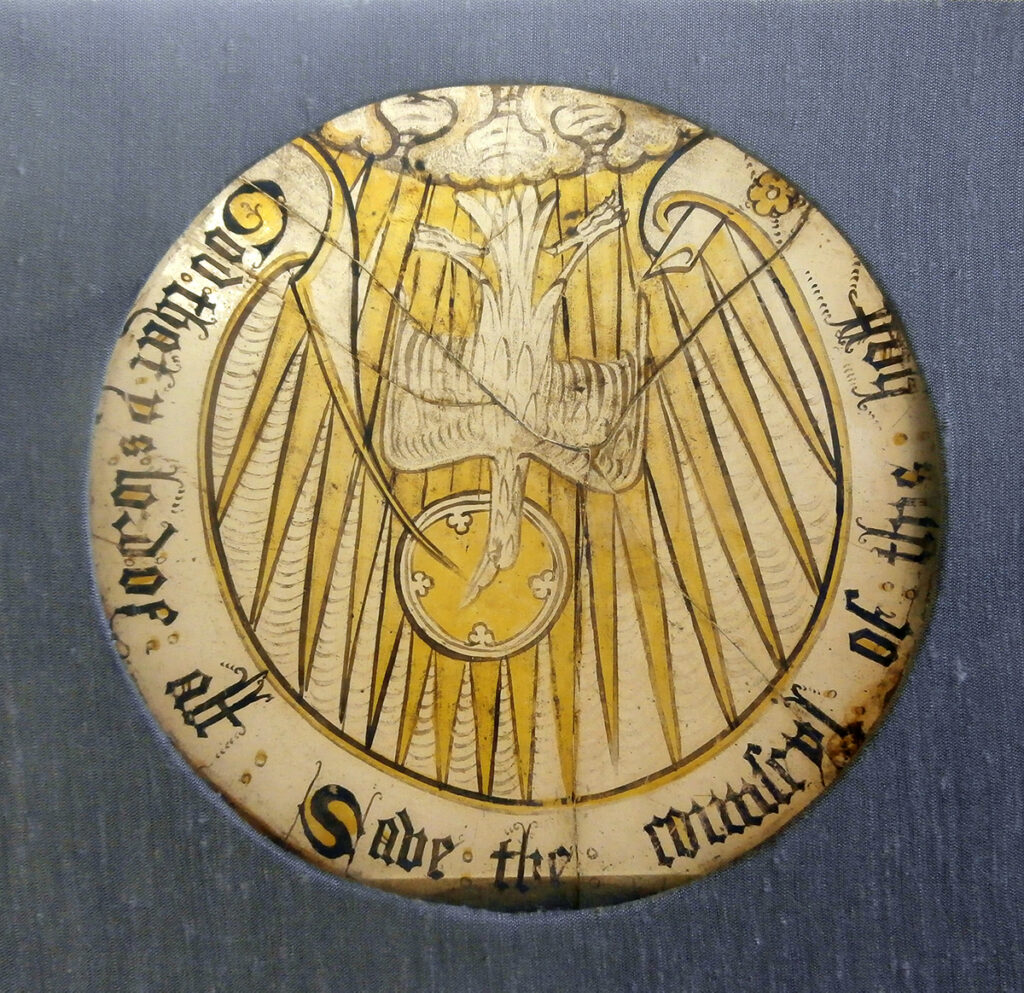
Guild Hall Window
AXBRIDGE MAYORAL CHAIN (1895 – 1974)
This chain was used by the Chairmen of the now defunct Axbridge Rural District Council. It has 14 silver disks, eight of which are blank. Each engraved disk records two holders of the office, as follows: 1895 – 1896 Evan H Llewellyn 1 year 1896 – 1918 Wm Peteram J.P. 22 years 1918 – 1920 Robert Board 2 years
1920 – 1926 H C Marshall 6 years1926 – 1927 G S Wall 1 year 1927 – 1947 Col A H Yathan DSO J.P. 20 years 1947 – 1958 S.A.Walter J.P. 11 years 1958 – 1961 C J Cook J.P. 3 years 1961 – 1963 E J Banwell MBE J.P. 2 years 1963 – 1967 Lt Col. J M Lee DSO J.P. 4 years 1967 – 1969 L C Dibble J.P. C.C. 2 years 1969 – 1974 J G Walter 5 years
In 1954 a pendant was added to commemorate the Councils Diamond Jubilee.
THE AXBRIDGE MACES (1623)
The Maces date back to the reign of James I, when a Charter of 1623 granted Axbridge the right to have two Maces. One was to be carried by the “Sergeant-at-Mace”, who would be elected after nominations and whose duty was to attend the Mayor. The other was to be carried by the Bailiff, an annual office, originally selected from amongst the Inferior Burgesses. Both were to proceed in front of the Mayor bearing gilt or silver maces engraved with the Royal coat of arms.
The Maces were restored around 10 years ago. They are both extremely fragile and have, in recent years, only been used on three ceremonial occasions: • Mayor Making; • the Civic Service, and • Remembrance Day.
Axbridge school-leavers also have the privilege of viewing them shortly before their last day at school here. The only other use is in the Axbridge Pageant, held every 10 years.
The Lamb & Flag is engraved on the foot of each Mace as shown.
The Maces were retired from public use in 2020.
Foot of the Mace
The Maces
DATES & TOWN DOCUMENTS
Axbridge has a wealth of historical documents some dating back to the 13th century:
1204 King John charter (15th century Inspeximus (Royal copy)) Burgesses market rights, Jury Service exemption, freedom from interference from the sheriff;
1229 King Henry II charter Grants freedom of tolls to various clerics, including the Bishop of Bath. As their subjects are also included, this extended to all the Traders in Axbridge.
1279 Edward I charter Grants a Fair on the eve of the Feast of St Barnabas and 3 days following (the Feast Day is the 11th June)
Many other documents of this period are deeds of properties. However, they also include a Manumission (freeing a serf or slave) and a “Stentar,” which lists all the properties owned by the Guild in 1468.
1557 Mary I charter (of King Philip & Queen Mary (Tudor)) The Craft Guild became a Borough Corporation and the former Portreeve became it’s Mayor. Various other officials were named.
Around 1557 a fascinating local history was compiled, the Axbridge Chronicle. The frontispiece gave a short history of the kingdom of England. Originally housed in an ancient chest in the Town Hall, the documents are now available for public research in the Somerset Record Office, Taunton. The chest is thought to be Elizabethan.
1559 Elizabeth I charter The Mary I charter was expanded to include job roles and responsibilities. More Fair Days were added (now up to four per year).
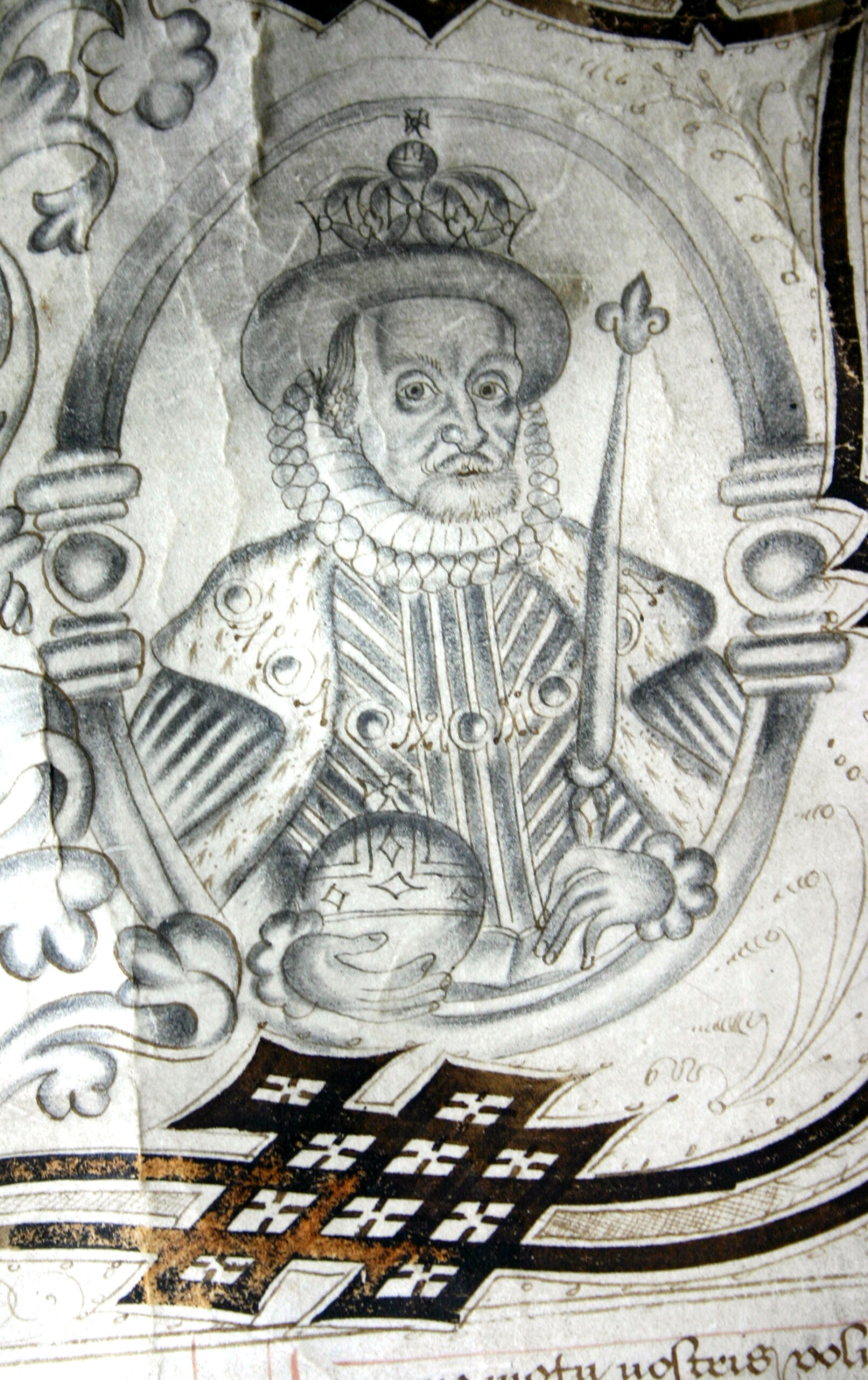
1623 James I charter Granted the use of two Maces. Extended the jurisdiction of Axbridge into the present day West St.
1229 Charter
James I charter
PAINTINGS
The Axbridge Town Trust also owns a number of paintings, mainly of former officials of the Corporation, the Axbridge Workhouse and the Axbridge Rural District Council. Most are only of local interest, but a picture of a member of the Fry family, plus one of his wife, who both lived in Axbridge, are included.
One particular painting, however, is very different from the others.
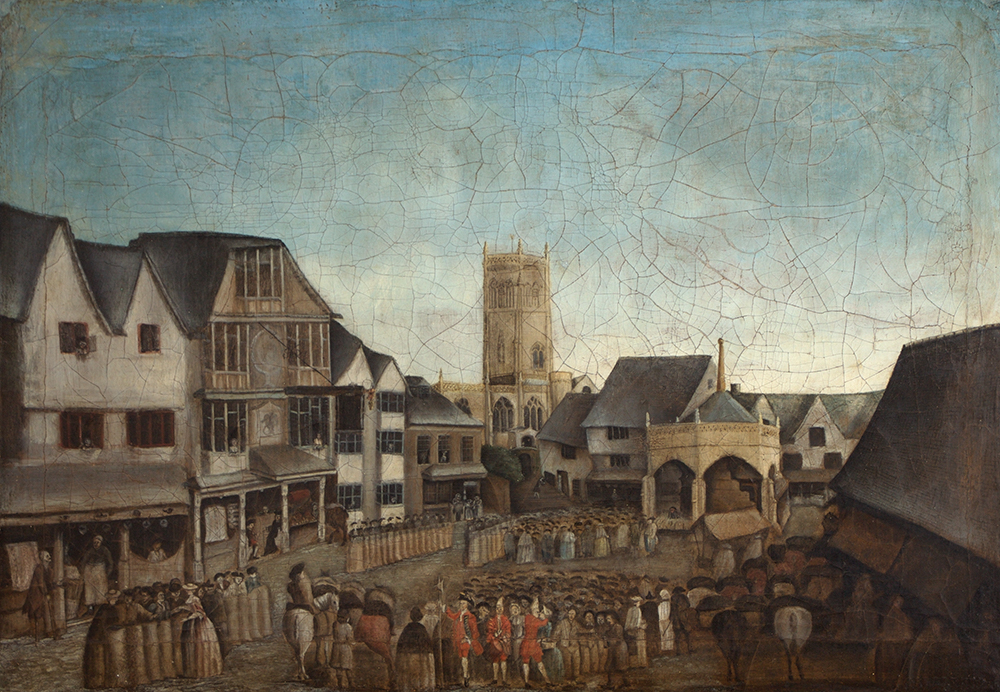
This is the Lady Day Fair (March 25th) picture, also known as The Hiring Fair, which took place in the open air on four days around Lady Day. This picture (just recently restored) was painted in 1730 or before and gives a wonderful insight into life at that time in Axbridge Square.
It has been used as a basis for cross curricula studies in a number of local schools recently, in a project known as Take One Picture and was enjoyed by both pupils and teachers.
Thomas Prowse was for many years the Recorder of Axbridge and an unopposed MP for the county in 5 Parliaments. He was nominated to be the Speaker of the House of Commons, but became ill and had to refuse. His Mother was Abigail Prowse, daughter of the Bishop of Bath & Wells, who made the altar cloth in Axbridge church.
The Hiring Fair
Bardwell, Thomas; Thomas Prowse (c.1708-1767)
BOOKS & THE COURT
A number of bound volumes of Parliamentary papers and Statutes from the time of Queen Anne and the Georgian period were given to the Corporation by one of its former Mayors. Presumably the Corporation continued to purchase additional papers, but although some were rather more crudely bound, others were left unbound and were thrown in a cupboard where they have been ever since. Other volumes contain information relating to Justices of the Peace, as Axbridge held a Court in the Town Hall until a new Court House was built behind the Police Station after WWII.
CLOCKS
Two clocks, owned by the Town Trust, are of interest because they were both made by Axbridge clockmakers. One is the main, two-faced Town Hall clock (pictured right), which can be seen above the balcony of the Town Hall, and from the Old Court Room inside. This was made prior to the Town Hall being built (1830) by a Thomas Williams (1790 – 1800). The clock was refurbished in 2012. Clockmaking had started in Axbridge around 1720 with William Brock. This was followed by a number of different makers including John Bilbie, William Curtis and George Williams of those that were documented.
The other is a grandfather clock, made by a member of the Maggs family and is from the 18th century. This clock was refurbished in 2017.