

Recently Axbridge acquired a new flag through the auspices of the Axbridge Town Trust, a charity setup in 1889 to acquire the assets of the Axbridge Corporation, which had been dissolved by the Municipal Corporations Act of 1883. It is now flying on the balcony of the Town Hall alongside the Union Jack (Fig. 1), with the blessing of the Axbridge Town Council, who have accepted it as the town flag.

Displayed on the flag is the motif which Axbridge has used since at least the Tudor period, but probably from even earlier, in the late medieval period (Fig. 2).
It features the lamb and flag, or Agnus Dei (Lamb of God), as it is also known (sometimes it is also referred to as the Paschal Lamb). It also contains a legend (the words around the edge), which states “Communitatis Burgi de Axbridge S(iggilum)” (The seal of the Community of the Borough of Axbridge).
That legend is interesting, as, in 1557 Axbridge acquired a royal charter, which turned it into a Corporation. Prior to that time it had no formal corporate status, though Domesday Book did record that it had thirty-two burgesses, who must have been originally formed sometime in the tenth century. Whilst it does appear to have had some form of independence since that time, it was not until the early thirteenth century that it acquired full independence from the royal estate at Cheddar.
It was in 1204 that King John gave the whole of his Cheddar estate to the Archdeacon of Wells, who then sublet Axbridge to Thomas Wallensis two years later. However, it may well have been the Archdeacon who organised the erection of the first church in Axbridge. That church acquired a dedication to St. John the Baptist, who, when he saw Jesus, is credited with the saying, “Behold the Lamb of God who taketh away the sins of the world.” This was a time when Axbridge had begun to establish itself as a local centre for the woollen industry. So, it does seem likely that both the dedication of the church, and the emblem adopted by Axbridge, were heavily influenced by that very profitable industry, though no example of the lamb and flag is known to exist from as early as the thirteenth or fourteenth centuries.
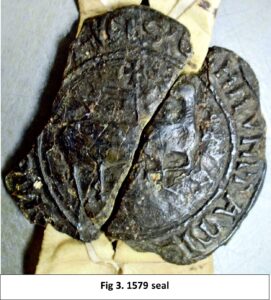
One of the earliest known versions of the lamb and flag appears on a seal from a document of 1579 (Fig. 3). Although this is after the charter of 1557, which definitely gave Axbridge the right to use a seal, it is a far less sophisticated version and looks as though it is a medieval design. It may well be an old seal being reused by someone who has no seal of their own. Whether it belonged to the Guild of the Blessed Virgin Mary, which ruled Axbridge until the Charter of Incorporation, is uncertain, but a possibility.
Unfortunately, it is not possible at the moment to check out a deed of 1420, which is listed in the catalogue as having “one pendant seal, lamb and flag,” as the Record Office in Taunton is closed during the pandemic. However that clearly signifies that lamb and flag seals were being used on documents in Axbridge for a long time prior to the 1557 charter.
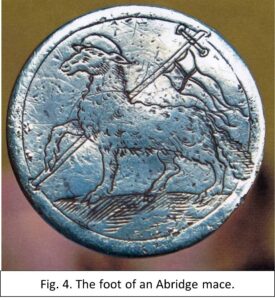
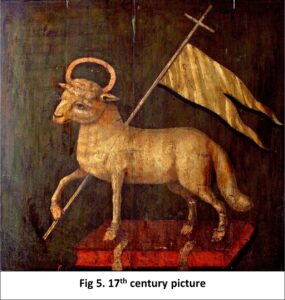
Unfortunately, most of the deeds held in the Axbridge Archive do not have the seal of the Corporation on them. This is because their seal would be on the copy deed held by a lessee, whilst the lessee’s seal would appear on the ones retained by the Corporation. However, there are some clues as to how the lamb and flag motif developed over time, from the crude version (Fig. 3), through two examples engraved on the feet of the Axbridge seals, which were granted to the Corporation in the third royal charter of 1623 (Fig. 4), a 17th century picture, currently in the King John’s Hunting Lodge Museum (Fig. 5), and some more recent versions from the eighteenth and nineteenth century (Figs. 6 and 7).
Noticeably, the lamb on the 1579 seal faces in the opposite direction to that of all the remaining versions, the cross differs substantially and the flag is much smaller and rather difficult to see. It also has its leg under its body, supporting the pole.
By 1623 (Fig. 4) the lamb faces to our left and the flag is a bifurcated banner with the lamb holding its pole in an outstretched foot, at the top end of which the cross is of a different style. The lamb is standing on a cross-hatched ground surface and has a rather flattened halo, which cannot be seen in the earlier version.
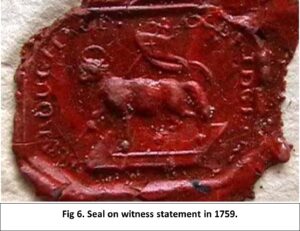
This is very similar, in many respects to the lamb shown in the museum picture (Fig. 5), though the cross here is plain and the banner no longer has the cross of St. George on it, but is now plain. Overall this is a far superior rendition, with a much larger and more pronounced halo. The major difference between the two, however, is what the lamb is standing on. On the foot of the mace it may not have been simple to show anything other than the cross-hatching displayed, but in the picture the lamb is now standing on a large book, which may well be a Bible, which has two prominent clasps across its long opening side. As early books were made of parchment, which had a strong tendency to absorb moisture, it quite often happened that the pages swelled up until it was impossible to close the book properly. To counteract this the clasps were used to hold the book firmly closed so that no moisture could get in and that which was acquired by the book when it was open, would be squeezed out. As parchment fell out of fashion when paper became the dominant material for books, clasps were no longer needed, as paper was not so absorbent. That had largely happened prior to the eighteenth century and this picture has been dated by experts to the seventeenth century. Another version of this lamb and flag can be seen on an octagonal seal, which is attached to a document dated 1759, so is probably quite an old seal by that time. Here the cross is similar to that of the one on the mace (Fig. 4) and the banner does have the cross of St. George upon it. In this case it is the octagonal shape of the seal border which is very rare and the legend around the edge merely states, “Borough of Axbridge,” in English. As it appears on a document which is stated to be a witness statement, is almost certainly the one that is used by the Justices of the Peace, rather than the Corporation itself.
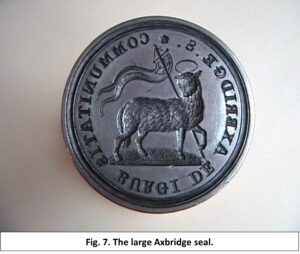
Two matrices (a matrix, or die, is the tool used to make the impression) still exist for Corporation seals. The larger one (Fig. 7) shows the lamb standing on a small mound, whilst the smaller one (Fig. 8) shows it standing on a field of grass.
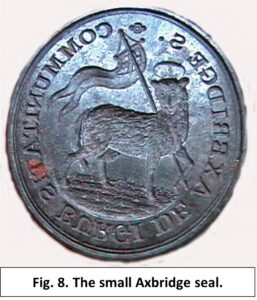
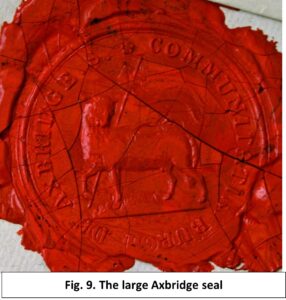
Both show the inverse of the seal, but a copy of the large one is available on a document (see Fig. 9). These are closer to the imagery shown on the modern Axbridge flag, except that today the leg of the lamb is draped over the pole, rather than resting on it (or holding it?) as formerly. All of them do have a major difference from all the earlier versions in that they now have the lamb looking over his shoulder, instead of looking forward.
All of this means that, whilst Axbridge has retained the lamb and flag as its symbol for possibly over eight hundred years, there has been quite a lot of variety over time. So, do have a look on the balcony of the Town Hall and enjoy the Axbridge flag flying alongside the national flag.